
The use of non-occluding off-ear audio speakers has significantly increased in recent years, driven by the growth of Augmented Reality (AR), Virtual Reality (VR), and smart glasses assistant products. These devices contribute to the existing array of products with off-ear audio, such as sport earphones, hearing assistants (hearables), and open ear headphones.
There are several advantages to open ear audio systems. In terms of comfort, the ear pinna and tragus are highly sensitive, making it beneficial to leave them untouched for long-term product wearability. An open design also eliminates concerns about thermal buildup. Furthermore, the acoustic waves of the sound source to naturally diffract around a user's ear which has benefits for perceived spaciousness (stereo image/ERTF) and sound source localization, contributing to the advancement of AR/VR scene realism.
However, a major audio issue with these devices is usually limited bandwidth. Traditional headphone designs require a seal to the ear to reproduce low frequencies with a small driver. Conversely, sealed box microspeaker designs such as those found in laptops and cell phones need a large speaker diaphragm or displacement (volume velocity) and back air volume to produce both low frequencies and the required output level. Such a large and heavy implementation is not typically possible on head-worn products. High frequencies are also often compromised by porting designs and diaphragm break-up modes. This article demonstrates a method of open ear speaker design known as the Dipole design, which utilizes the proximity effect to enhance low-frequency output and increase privacy (the ability of others nearby to hear the wearer's audio). One potential tradeoff, among many possibilities, is illustrated when implementing the dipole effect stretched excessively, impacting high-frequency response.
There are several advantages to open ear audio systems. In terms of comfort, the ear pinna and tragus are highly sensitive, making it beneficial to leave them untouched for long-term product wearability. An open design also eliminates concerns about thermal buildup. Furthermore, the acoustic waves of the sound source to naturally diffract around a user's ear which has benefits for perceived spaciousness (stereo image/ERTF) and sound source localization, contributing to the advancement of AR/VR scene realism.
However, a major audio issue with these devices is usually limited bandwidth. Traditional headphone designs require a seal to the ear to reproduce low frequencies with a small driver. Conversely, sealed box microspeaker designs such as those found in laptops and cell phones need a large speaker diaphragm or displacement (volume velocity) and back air volume to produce both low frequencies and the required output level. Such a large and heavy implementation is not typically possible on head-worn products. High frequencies are also often compromised by porting designs and diaphragm break-up modes. This article demonstrates a method of open ear speaker design known as the Dipole design, which utilizes the proximity effect to enhance low-frequency output and increase privacy (the ability of others nearby to hear the wearer's audio). One potential tradeoff, among many possibilities, is illustrated when implementing the dipole effect stretched excessively, impacting high-frequency response.
Smart Glasses Free-Field Measurement
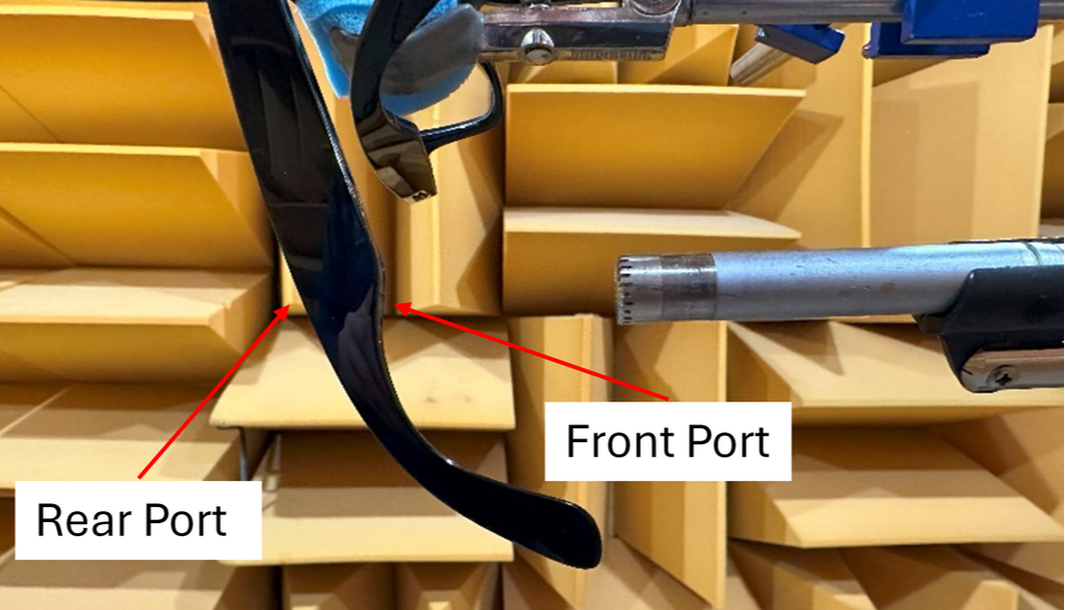
A commercially available smart glasses product has two ports for the speaker in the stem near the ear:
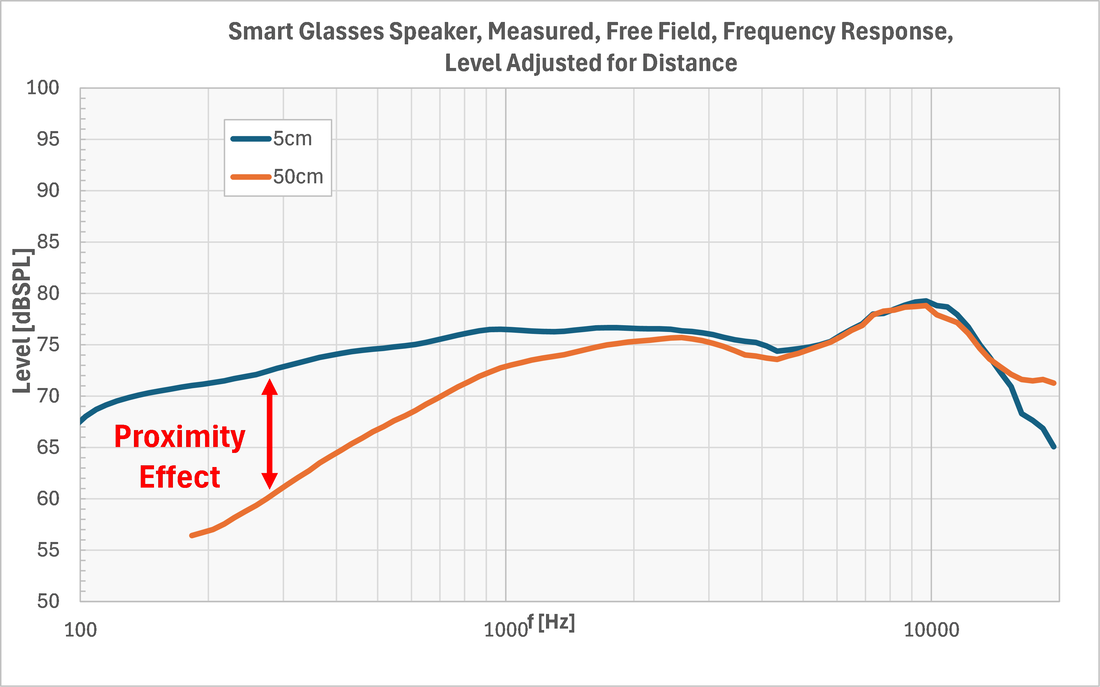
The dipole speaker design of the smart glasses provides greater than 10dB improvement in level below 300Hz at short distances, even after adjusting for expected level shift due to distance. This is the observed proximity effect. This is identical to how a gradient microphone also has proximity effect when used in the nearfield:
Smart Glasses Simulation
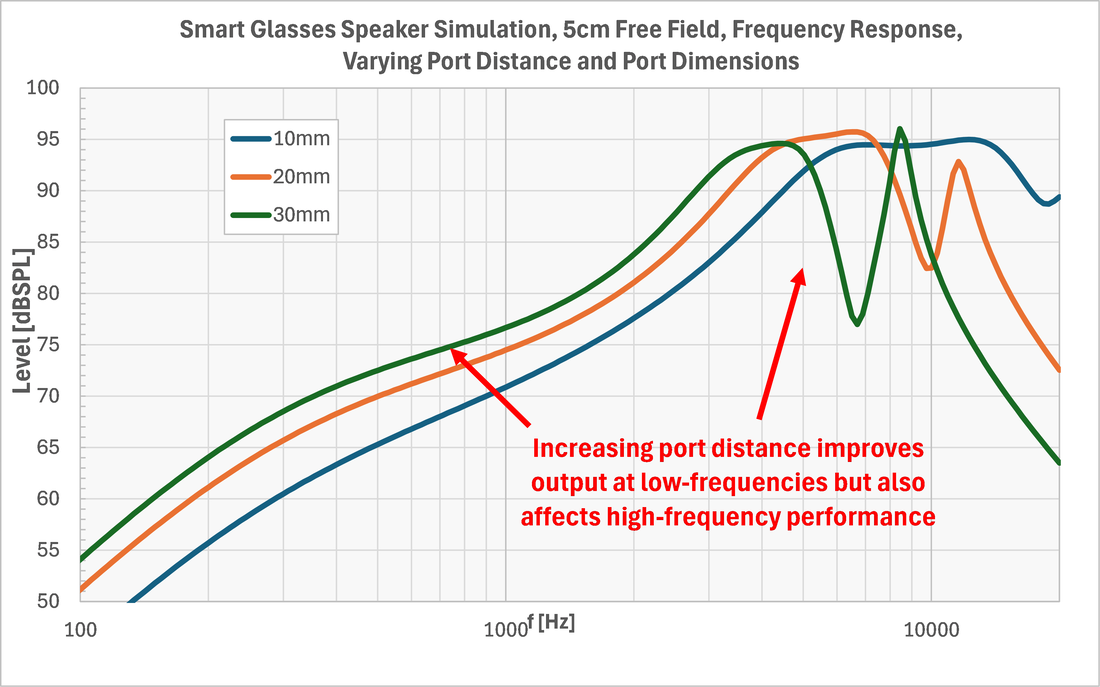
| Acoustic simulation is a useful tool to determine the sensitivity of the output to various input parameters, even if physically realizing the geometry is difficult or impossible. IAR often uses lumped element method (LEM) simulation to quickly guide design decisions. Here, LEM has shown Low-frequency output can be improved by increasing the distance between the speaker ports in the stem of the glasses: | 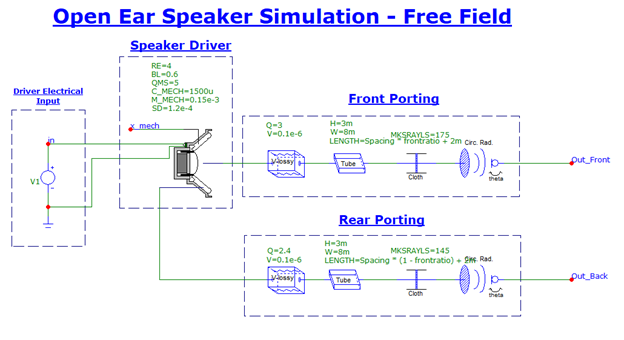 |
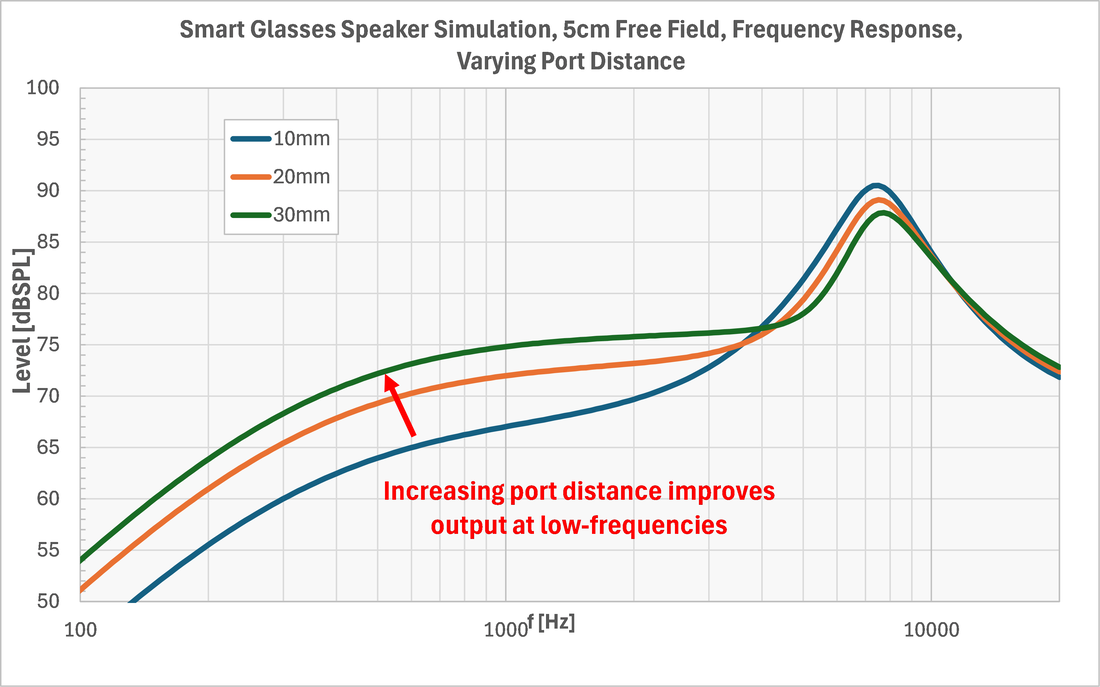
This port stretching is done easily in simulation by magically entering a larger distance between the speaker outlets. However, this is not physically realizable without making the internal ports to the front and back of the speaker proportionally longer. When port dimensions are allowed to stretch with increased spacing, high-frequency response will be affected.
The need for open ear speaker designs has presented challenges to achieve comparable performance to traditional earphones. A dipole speaker design can solve several issues with acoustic performance and comfort, but requires careful consideration of design constraints. Innovative design solutions continue to push the boundaries of what these speakers can offer in terms of comfort, privacy, and audio quality.

 RSS Feed